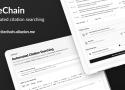
Outil libre de recherche de citations, basé sur les données de OpenAlex et Semantic Scholar, qui permet de faire les backward & forward citations chasing en une seule fois et d'exporter les résultats au format RIS
publié sur Github sous licence AGPL-3.0


Build a reproducible systematic-review search in OQL — term blocks, exact vs. stemmed matching, and scope filters.
partagé par Cécile / signalé par Anne
useful resources collected by Julie Glanville for citation analysis and citation searching
Standard
C 37 Rerunning searches :
Rerun or update searches for all relevant sources within 12 months before publication of the review or review update, and screen the results for potentially eligible studies.
Rationale and élaboration
Mandatory:
The published review should be as up to date as possible. The search must be rerun close to publication, if the initial search date is more than 12 months (preferably six months) from the intended publication date, and the results screened for potentially eligible studies. Ideally the studies should be incorporated fully in the review. If not, then the potentially eligible studies will need to be reported, at a minimum as a reference under ‘Studies awaiting classification’ (or ‘Ongoing studies’ if they have not yet completed).
Resources
See Handbook Section 4.4.10
mention explicite du délai localisée par Joëlle
When initiating searches, consider the possibility of future updates of the searches. Sometimes, search alerts or searches saved in the native databases may be set up at the same time as the initial searches are performed. This can save time in the long run and prevent unnecessary deduplication of search results or the elimination of duplicate information. A final search of the databases may also be needed if the length of time has elapsed between the start of your review and your preparation to write up the final paper, if search alerts have not been used or if changes need to be made to accommodate new vocabulary or relevant search terms. The JBI Evidence Synthesis journal will not accept systematic reviews where the search is older than 12 months from the date of submission, as stated in the JBI Evidence Synthesis Information for Authors.
Where possible, and especially for rapidly changing topics, 6 months is the ideal, although it is not required (Higgins et al. 2018). You may also wish to use this as an opportunity for refining your search again, not including search terms or databases that were not fruitful during the initial stages of your search, although any changes to the search should be explained within either the description of the search methods in the final review or in the appendix.
mention explicite du délai localisée par Joëlle
Guide sur les revues systématiques mis à disposition librement (CC BY-NC-SA 4.0) par le Gerstein Science Information Centre de l'Université de Toronto
Astuce pour rechercher une expression contenant p. ex. un apostrophe (ou tout autre caractère réservé) dans Embase

Aide expliquant comment Covidence dédoublonne les résultats qui y sont versés
This research proposal focuses on developing a living literature review on just sustainability transitions, addressing the challenges of information overload, knowledge synthesis and dissemination in academic research. We aim to assess the potential of Wikidata for creating an enriched, searchable academic knowledge graph on just sustainability transitions in order to facilitate navigation of existing academic knowledge and synthesis of research findings. [...]
Signalé par Noémi
Chapitre sur la stratégie de recherche du JBI Manual for Evidence Synthesis, présentant la méthodologie JBI
AMSTAR stands for A MeaSurement Tool to Assess systematic Reviews. There has been a proliferation of systematic reviews as one of the key tools for evidence-based health care. This has presented both opportunities and risks. [...] The risks include variation in quality and empirical validation.
Exemple de collection de références pour une revue systématique
This dataset contains a collection of papers retrieved by using a PRISMA systematic review of Open Data and Public Domain data in Agriculture. This collection of papers uses, creates, or discusses about Open Data and Public Domain.
The dataset uses the Zotero RDF format and is classified according the source and the topic of the paper
Exemple de fichier RDF rendant (partiellement) compte des traitements successifs des références au cours d'une scoping review
Outil développé par Michael Gusenbauer permettant de comparer les bases de données pour cibler les bonnes ressources (ou simplement avoir une meilleure vision d'ensemble de ce que nous avons à disposition)
A free tool to give you the confidence to search the best databases available, so you find all you need, faster.
découvert grâce à Frédérique
Padlet contenant les slides, les exercices et de la documentation en lien avec le workshop "Can we use OpenAlex for systematic searches?" donné par Claire Stansfield à EAHIL 2025

Formation de la Medical Library Association sur l'utilisation d'EndNote dans les revues systématqiues, donné par Wichor Bramer
outil de dédoublonnage de références provenant de diverses bases de données
Removing duplicate references obtained from different databases is an essential step when conducting and updating systematic literature reviews. ASySD (pronounced "assist") is a tool to automatically identify and remove duplicate records.
À tester !
découvert grâce à Myriam (UNIGE)
Outil de recherche d'articles citant ou étant cité par une publication
Utile pour la phase de citation chasing d'une revue systématique moyennant de passer par l'API pour réaliser plusieurs requêtes, car l'interface de recherche semble limitée à la recherche d'une seule publication à la fois
Les données (publiées sous licence CC0) peuvent également être téléchargées pour travailler en local : https://download.opencitations.net/
"OpenCitations is managed by the Research Centre for Open Scholarly Metadata, an independent research centre within the University of Bologna." -- https://opencitations.net
Outil de recherche d'articles citant ou étant cité par un set de publications
Utile pour la phase de citation chasing d'une revue systématique
Powerful evidence synthesis tools for medical researchers. Accelerate, collaborate, automate and share.
Outil d'aide à plusieurs étapes d'une revue systématique, mais dont je n'ai pas encore pu tester l'utilité, l'efficacité et la transparence...